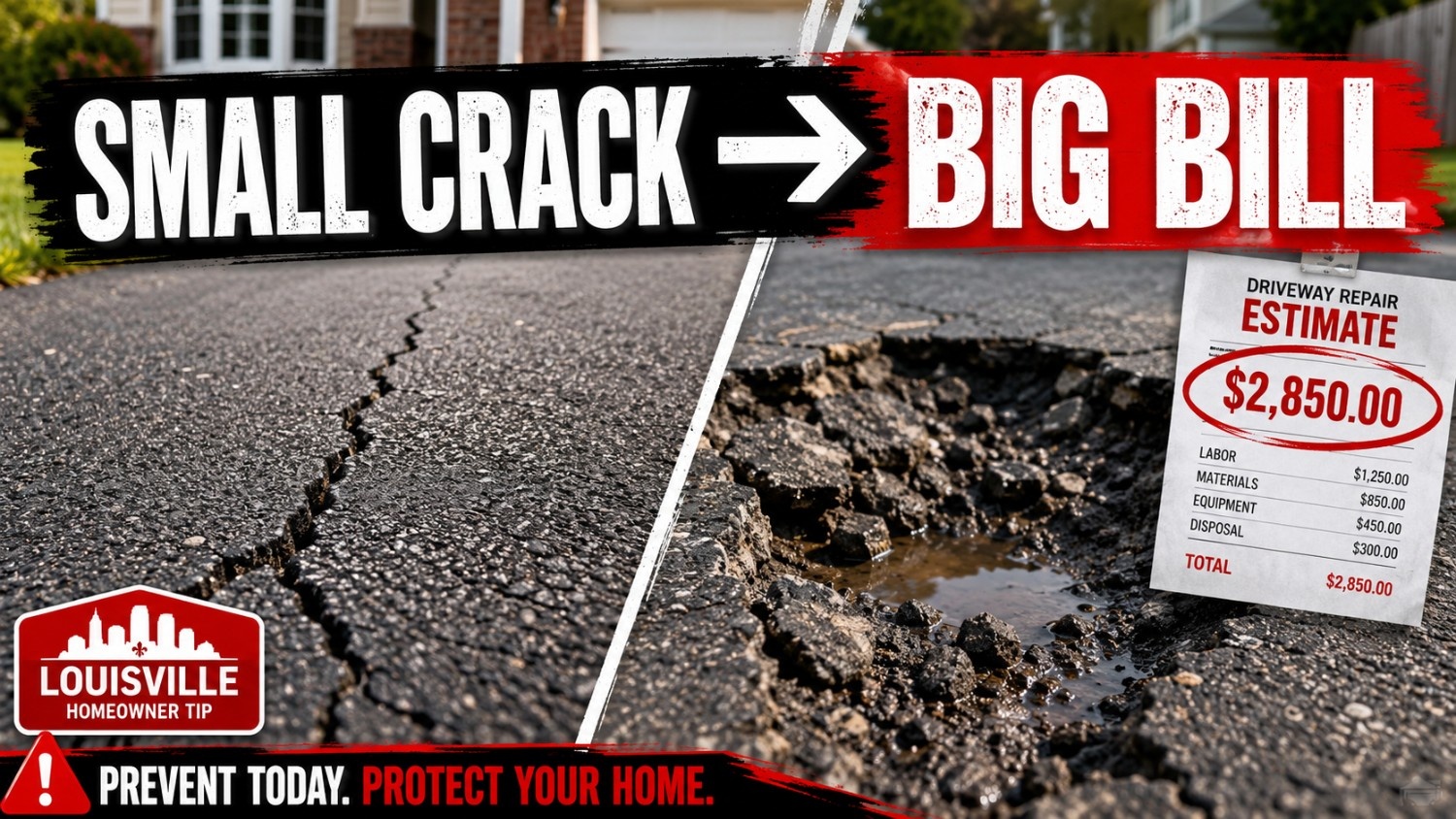
The Hidden Cost of Ignoring Small Driveway Cracks
A small crack in a driveway is easy to dismiss. It is not a safety hazard, it does not affect how the driveway functions day to day, and fixing it feels like a low-priority task compared to everything else competing for a homeowner's attention and budget. But small cracks in concrete and asphalt driveways do not stay small — and what starts as a minor surface issue has a predictable pattern of becoming a significantly more expensive one.
How a small crack becomes a large problem
Water is the main driver of driveway deterioration, and cracks are how water gets in. Once moisture penetrates the surface, it works its way into the base material beneath. In Louisville's climate, where temperatures regularly swing above and below freezing in the same season, that trapped water expands when it freezes and contracts when it thaws. Each cycle widens the crack slightly. Over a few winters, what began as a hairline fracture becomes a gap wide enough to catch a heel or a bike tire, and the edges of that gap start to crumble.
The problem compounds because cracks rarely appear in isolation. As the base material shifts and settles from moisture intrusion, stress concentrates at other points in the surface and new cracks form. A driveway that had one small crack in the spring can have a network of damage by the following year if the original crack was not addressed.
The real cost comparison
Filling a small driveway crack is a straightforward and inexpensive repair. Professional crack filling in Louisville typically costs between $100 and $300 depending on the number and size of cracks, and a quality sealant applied afterward extends the life of the repair considerably. This is the cost of addressing the problem while it is still small.
The cost of waiting looks entirely different. A driveway that has deteriorated to the point of widespread cracking, crumbling edges, or heaving sections typically requires either extensive patching — which is never invisible — or full replacement. Driveway replacement in Louisville runs between $4,000 and $15,000 or more depending on size and material. That is not a repair cost. That is a major home improvement project that could have been deferred for many more years with basic maintenance.
What proper crack maintenance actually involves
Addressing driveway cracks correctly means cleaning the crack thoroughly to remove debris and vegetation, applying a flexible filler appropriate for the crack width and the driveway material, and sealing the surrounding surface to prevent new moisture intrusion. Doing only part of this process — filling without sealing, or sealing without proper prep — produces results that fail quickly and leave the homeowner back where they started.
Louisville homeowners should inspect their driveways every spring after the freeze-thaw season and address any new cracking before the next winter. An annual or biennial sealing schedule keeps the surface protected and significantly extends the time before any major repair or replacement becomes necessary.
Frequently Asked Questions
How long can I wait to fix a small driveway crack? The sooner the better. Small cracks are cheapest to repair and easiest to seal. Waiting even one winter can allow freeze-thaw damage to significantly expand the crack.
Will crack filler make my driveway look like new? Crack filler addresses the structural issue but will typically remain visible on the surface. A full seal coat applied after filling blends the repair and restores a more uniform appearance.
How often should a Louisville driveway be sealed? Most asphalt driveways benefit from sealing every two to three years. Concrete driveways generally need sealing every three to five years. Driveways with existing cracks should be sealed more frequently.
Is it worth repairing an older driveway or should I just replace it? If the surface has scattered cracks but the base is still sound, repair and sealing is almost always the better value. Replacement makes sense when the base has failed or the surface damage is too widespread to address economically.
