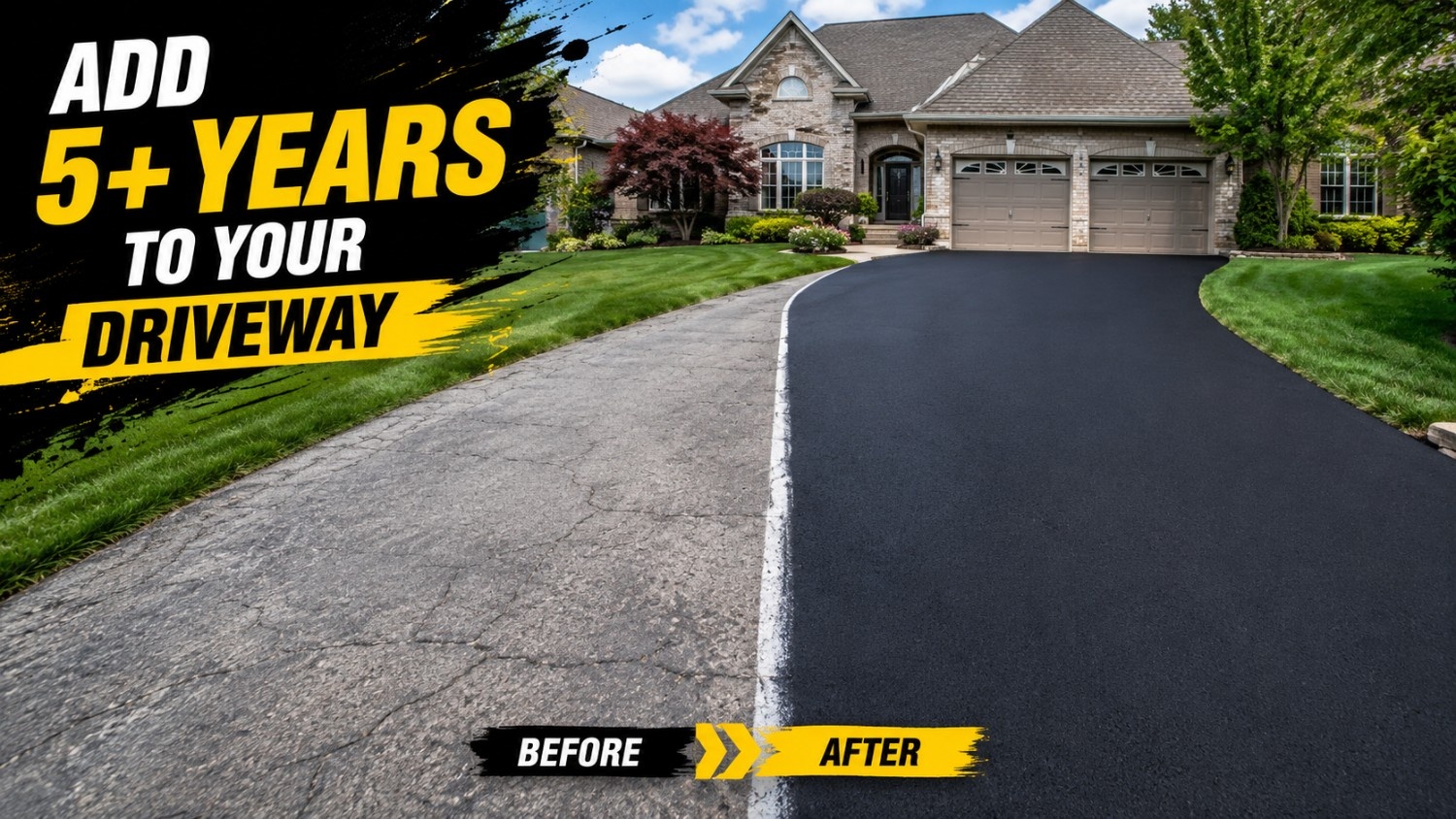
Your Louisville Driveway Is Aging Faster Than You Think (Here's How to Add 5+ Years to Its Life)
Most Louisville homeowners do not think about their driveway until something goes visibly wrong — a crack wide enough to trip on, a surface crumbling at the edges, or a stain that will not come clean no matter what. By that point, the damage has typically been building for years. Driveways age in ways that are easy to overlook until the deterioration crosses a threshold that demands attention, and Louisville's climate accelerates that process more than most homeowners realize.
Why Louisville driveways age faster than average
Louisville sits in a climate zone that delivers the worst of multiple worlds for paved surfaces. The city averages more than 60 freeze-thaw cycles per year — days where temperatures cross the freezing point in both directions. Each cycle drives moisture deeper into surface cracks and expands it as it freezes, widening the crack a little more each time. Add in the region's significant rainfall, occasional ice storms, and summer heat that causes asphalt to soften and shift, and Louisville driveways face year-round stress that compounds quickly without maintenance.
UV exposure contributes significantly as well. The oils that keep asphalt flexible and bound together oxidize under sunlight over time, leaving the surface brittle and prone to surface cracking. A driveway installed ten years ago in Louisville without any sealing in between has likely lost a meaningful portion of its original structural integrity — even if it still looks passable from a distance.
The maintenance steps that actually extend driveway life
Sealing is the single highest-impact maintenance task for both asphalt and concrete driveways. For asphalt, a quality sealcoat replenishes surface oils, blocks UV penetration, and creates a barrier against moisture intrusion. Applied every two to three years, it dramatically slows the oxidation and brittleness that leads to cracking. For concrete, sealing prevents moisture from reaching the subsurface and protects against the salt damage that Louisville winters bring when roads and driveways are treated for ice.
Crack filling before sealing is equally important. Sealing over unfilled cracks does not address the underlying damage — it simply covers it temporarily while water continues to penetrate underneath. The correct sequence is always crack repair first, followed by sealing once the filler has cured. Skipping this step wastes money on the seal coat and delays a problem that will resurface within a season.
What a proper maintenance schedule looks like
A Louisville driveway on a consistent maintenance schedule should be inspected each spring after the freeze-thaw season ends. Any new cracking should be filled and allowed to cure. The surface should be cleaned of oil stains, debris, and vegetation growing in cracks before any product is applied. Sealing should follow on the appropriate cycle for the driveway material.
Homeowners who follow this schedule consistently report that their driveways remain in serviceable, attractive condition significantly longer than those who address issues only when they become urgent. The math is straightforward: a driveway that costs $250 to seal every three years is a driveway that may not need a $10,000 replacement for 20 or more years. One that receives no maintenance may need replacement in half that time.
Signs your driveway needs attention now
Surface fading and graying on asphalt, hairline cracking across the surface, small cracks near edges and expansion joints, and minor crumbling at the driveway border are all early-stage signs that are inexpensive to address. Alligator cracking — a pattern of interconnected cracks resembling scales — indicates base layer damage that is more serious and more expensive to repair. Catching deterioration at the early stage is the entire value proposition of routine maintenance.
If your Louisville driveway has not been sealed in more than three years, has visible cracking that has not been filled, or shows surface fading and brittleness, it is already aging faster than it should. The window to extend its life significantly with low-cost maintenance is open — but it does not stay open indefinitely.
Frequently Asked Questions
How do I know if my driveway can be saved with maintenance or needs replacement? If the base layer is still intact and damage is limited to surface cracking and oxidation, maintenance and sealing can extend the driveway's life significantly. Widespread alligator cracking, sinking sections, or base failure typically indicate replacement is the better path.
What is the best time of year to seal a Louisville driveway? Late spring through early fall, when temperatures are consistently above 50°F and no rain is expected for 24 to 48 hours after application. Avoid sealing in summer's peak heat, which can cause the sealant to dry too quickly and streak.
Can I seal my driveway myself or should I hire a professional? DIY sealing products are available, but professional-grade materials are significantly more durable and the application process — proper prep, correct product selection, even application — makes a meaningful difference in how long the result lasts.
How much does professional driveway maintenance cost in Louisville? Crack filling typically runs $100 to $300. Professional sealing for a standard residential driveway runs $150 to $400. Both together represent a small fraction of what driveway replacement costs and can defer that expense by many years.
